In our third iTWire research (27th February 2026) conversation with Desmond Seeley, Delivery Executive at the Commonwealth Bank of Australia #CBA, the nitty-gritty of Digital Transformation in the DevOps function of a complex institution is considered.
In our previous conversations, the “Why” and “What” of Digital Transformation in DevOps was discussed. At the #CBA, “Platform Engineering” has been identified as the required solution, based in part on the Google Model a significant extrapolation of the “portable” operating system.
In this conversation, Des describes in detail the juggling exercise required to align a number of separate initiatives and priorities, perhaps half a dozen along a common path….and keep them there.
Many of the ideas will be familiar though possibly under-appreciated in the zeitgeist and can be generally applied – iterative development, modular component delivery, identification of an early-adopter (“guinea-pig” or “champion” ?), marketing and selling the approach, essential where there is an element of “deferred gratification” where funds are allocated to the development of an “productive asset”, an engine that will deliver improved future results.
How do you mesh the gears?
Note for listeners and viewers – momentary glitch between 8.00 and 9.00 minutes in after which normal service is resumed !
Has the addition of “AI” engagements improved the customer experience? Is the Raspberry Pi cooked?
The “AI” Mercury Switch at ii-net
How’s your broadband going? If you are with ii-net in Australia you’ve probably found that if it isn’t going too well then when you call them up, instead of the simple pressing of a few buttons to get you to some one who has a good idea what’s going on (usually the case it has to be said) there is a new intervention: an emulation of a hapless adolescent posing the question “how can I help?”
In a sentence.
Problem? Even if you could construct a reasonable and publishable sentence to describe your current state of NBN despair, you cannot make yourself understood as the mobile phone no longer carries a signal of sufficient clarity to convey a message of any substance so the meaning is lost.
And time wasted. Why?
An agent at ii-net and I were having a laugh about my wasted time and he suggested that the “AI” intervention was needed to meet the requirements of the young. After all, the young are blessed with much time, though as Mose Allison implied perhaps little else.
The Irritating Avatar
Hold on, what’s going on? Crafting is going on and a strong recommendation is the “30 Days as Lost in Space” kit from Crafting Table. As stated on the tin, perfect for beginners.
What however is this that stands before me? An intervention by a curious being seemingly half way between everywhere; red dwarfed by Youtube. Is this “thing” necessary or a distraction from the tasks engaged?
Try out the kit and you be the judge.
Raspberry Pi or Pickle
The squeezed middle is a painful place to be.
Total cost of purchase of a working pi?
keyboard, mouse, sd card and monitor is getting for four hundred Australian bucks. A fully configured low-spec laptop with windows and office price in fact for which one can grab a full-fat python for free.
The unboxing wasn’t great; screwholes but no screws and the cooling fan connector with the power on the board was a bit fiddly. And then it broke or least the connection didn’t conduct; No fan.
The OS download was OK but then the monitor went into sleep mode and wouldn’t wake up either with ubunto or raspberry os. What to do? Lots of online guidance that assumed prior knowledge lead to a few changes to the config.txt with notepad and a re-boot. No luck. Another monitor, I don’t think so as the one in use displayed switch-on diagnostics just fine and worked with the laptop. It’s not worth the money.
To program? Back to the laptop,
The Heath Robinson hack appeal of the pi still attracts but maybe, like many artefacts and initiatives in the technology world, commodification has come for its lunch.
A visit to the National Museum Australia reveals the nature of things and those things are systems.
It was my pleasure to make a visit, with fellow students, to the National Museum Australia on Friday 19th February 2026 in the company of Professor Katherine Daniell, Interim Director of the ANU College of Systems & Society, School of Cybernetics and Associate Professor Ash Lenton, Convenor of this year’s Master of Applied Cybernetics course.
Exhibit A – For Fish
The fish traps of Brewarrina “Baiames Ngunnhu” are famous for a number of reasons fully articulated elsewhere (Baiame’s Ngunnhu, Nonah). Far from trivialising these constructions, from another perspective as described by Professor Daniell, they can be abstracted as a system, in which challenges and resultant functional features can be analysed by cybernetics.
For example, the migration of fish down the Darling River, can be represented as a flow of information subject to change. How are the active processes and mechanisms (intended to perform the delivery of food by capture) at Brewarrina to be adapted to or altered by often capricious, precipitous and violent change within the meandering evolution of the watercourse. Question? Could the design and implementation of processes and mechanisms be changed to improve the performance of the system? If so how and at what cost? How has the new fishway at the site contributed to productivity?
Exhibit B – Socrates, Gorgets and Nova’s Olympic Gold Medal
The introduction to the group of “Socratean dialogue” by Associate Professor Ash Lenton provided an engaging and reflective means for the consideration of the systems required for the manifestation of the displayed artefacts.
Complex supply chains, cybernetic systems stretched in trading webs across the globe, were a recurrent theme illuminated by the display of breastplates (more specifically “gorgets” in this article from the NMA) and the Gold medal earned by Nova Peris at the 1996 Olympics with the Hockeyroos, still an extraordinary achievement.
Exhibit C – Jack Brabham
Thirty years prior to Nova’s triumph, another Australian achieved a remarkable feat, never replicated before or since, that of a Formula 1 championship as driver, engineer and owner. Arguably underappreciated in his own land, the legend that is Sir Jack can be revisited in the NMA’s collection.
Again, the extraordinary power of cybernetic information exchange was evidenced as Repco took the Oldsmobile block from the U.S.A. to Australia and created an engine to compete in, at that time, the most European of contests (the Repco engine).
On “Digital Transformation” in DevSecOps at the CBA; using modular-construction platforms for the support of digital product delivery.
The “What?”
In this conversation, second in a series of three (Why?, What?, How?) with Des Seeley, Delivery Executive at the Commonwealth Bank of Australia, the features and characteristics, benefits and costs of the “Platform Engineering” approach are considered.
The Google Model
Thirty years since Section 230 initiated the “platform” concept for “digital media” and paradoxically as vendor work platforms are under market pressure, the contemporary manifestation of the “portable operating system” offers a strong argument for adoption where industry-sector or organisation specific digital products are in continuous demand.
On the 30th Anniversary of the Legal Ruling (Section 230 (c) (1)) that for better or worse, cast the nature of our times, technology in the form of “AI” agents has driven the lucrative “platform” gravy train into the buffers.
Let’s look at those share prices again
Service sector work platforms derived from the search and social media platforms that flourished under the protection of Section 230 (c) (1) have proved highly lucrative in the age of digital paper-pushing. Markets however seem to think that “AI” might be about to eat their lunch, as at 5th February 2026:
PEGA – down 43% in five years, down 29% YTD
Salesforce – down 16% in five years, down 21% YTD
Workday – down 35% in five years, down 17% YTD
SAP – up 54% in 5 years, down 16% YTD
Atlassian – down 56% in 5 years, down 32% YTD
ServiceNow – down 5% in 5 years, down 25% YTD
Monday.com – down 44% in 5 years, down 27% YTD
According to the UK’s Daily Telegraph “AI’s apocalyptic jobs prophecy is about to become reality“, the future is now and markets, are jumping, perhaps to premature conclusions. It could be argued that these firms have been generously valued for an extended period and as such have become bloated and overburdened themselves with the bureaucratic impediments they propose to minimise in their client organisations.
Even if “AI” can deliver as prophised by its evangelists, the re-engineering of “legacy” systems and practice will be enormously expensive and time-consuming, battling both inertia and active resistance. What is perhaps universally true, is that benefits will accrue to early adopters while the frictions will accumulate over time, slowly but inevitably eroding any competative advantage.
Paul A. Strassmann’s book “The Economics of Corporate Information Systems: Measuring Information Payoffs” from an earlier era in the evolution of digital systems tells an interesting story.
A Minsky Moment
What is clear though, is that for the “platform players” and the management consultants that have feasted at their table, what cannot go on forever has finally stopped; a metaphoric and in some ways literal, “Minsky Moment”
Three conversations with Sydney-based technology leaders last week all started the same way: “We’ve got AI tools, but they’re not moving the needle.”
Gareth Davies of research2.au invited Des, C-Suite/Executive Leader, currently an Engineering Delivery Executive at the Commonwealth Bank of Australia #CBA for a discussion on the 2026 challenges faced by his team and enterprise function in a large, extremely complex, highly-regulated and very visible institution.
In this, the first of three conversations, the “Why?” question is applied. Terms are defined in the general and the specific, the current state of play in #DevSecOps as the function is known at the #CBA is understood and the proposed solution introduced.
In the next two conversations, the “What” and “How” will be considered.
Who can afford governance when it looks like this?
Whither AI?
In the current mania, much conversation centres around the concept of “AI” governance?
Why? and what is “AI” governance? Now and in the future.
The issue is this. Even if “AI” tooling can be acceptably governed (if this can be defined) how much is this going to cost. Does the cost of governance (a “friction”) militate the use of “AI” as the benefits no longer outweigh the costs.
For example, in automated systems, an assumption might be that a given set of inputs will always generate a given set of outputs. A cake recipe when followed with fidelity will produce a cake. Is the respect of this principle a “core competence” of “AI” without significant investment in guardrails, audit etc.
The use of ISO Standards
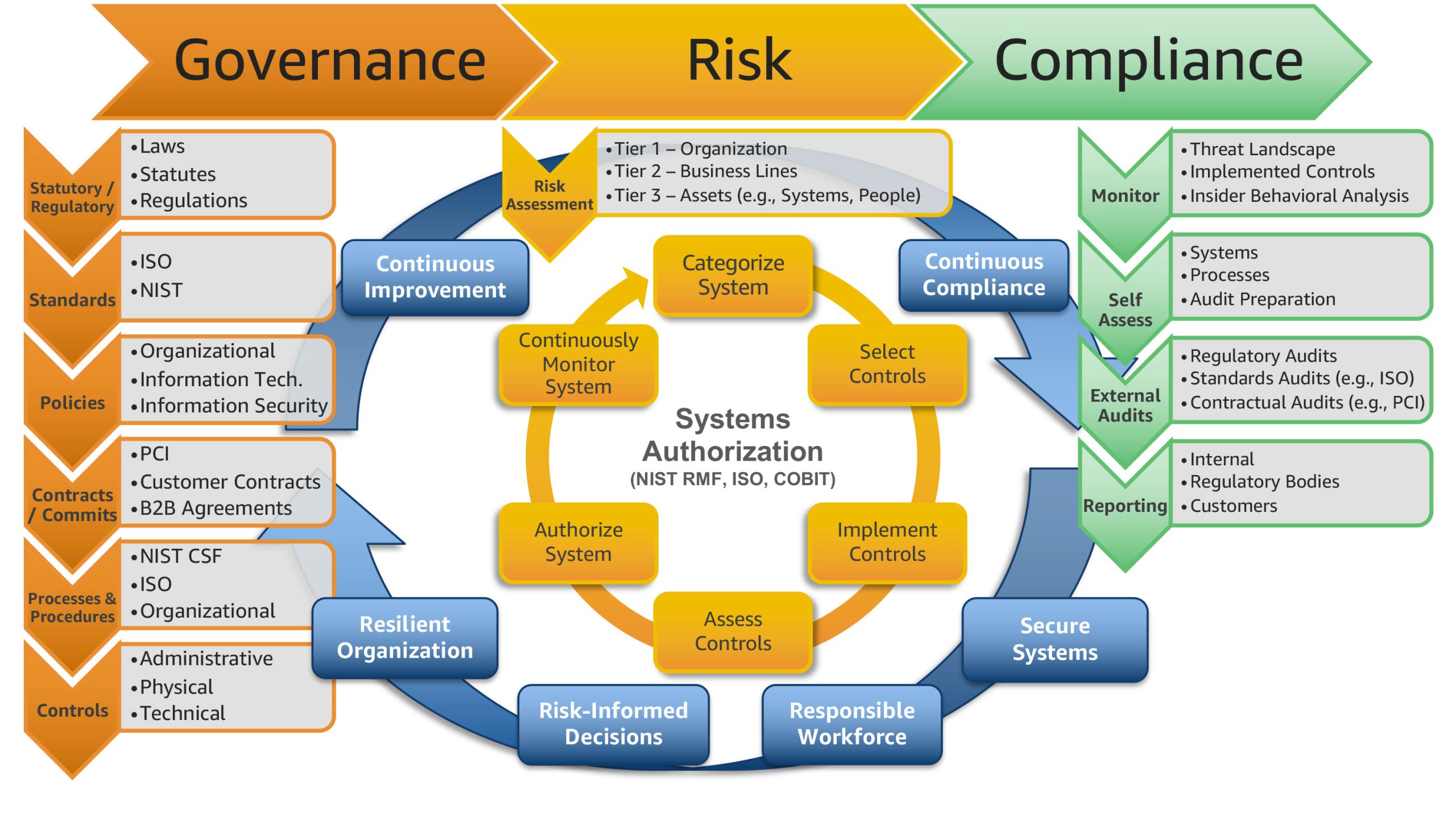
It can be argued that a mechanism for a reasonable response to the use of new technologies is the adoption of ISO standards e.g. ISO27001 and for “AI” ISO42001, given that independent first principle analysis and deployment of requirements will be beyond the resources of most organisations.
A feature of “platform engineering” could be that compliance and governance functionality is available by default to engineers in their work.
In fact, one of the benefits of the adoption of “public cloud” platforms is the availability of default compliance functionality from the platform – for example in “privacy” – by the certified ISO handling of “personal data” or “personal information” as defined by the applied regulation. It is hard to envisage the circumstances in which a regulator would object to the reliance of a “public cloud” customer on a provider from the current “Big Tech” cohort.
Tendency to Oligopoly at Best
Current valuations for “AI” suggest that investors are betting on the identity of the eventual number one of one provider of “AI” services, given the enormous capital costs required for its deployment.
Equally, the complexities of “AI” deployment suggest that there will be a tendency towards at best an oligopoly of suppliers in the provision of governance, preferably systemised as a commodity.
Oligopoly profits and pricing privileges for “Big Tech” await, again, this time as an unintended consequence of regulation and governance.
How information technology has reduced productivity by the empowerment of bureaucratic and regulatory “busy-bodies”.
Example number 1: 50 years of finding a flat.
1976
Process Chain
Walk about, try to find real estate agent through fog of beer.
Visit a few places (in old mini) where undergraduate students (boys) are welcome – not many it must be said.
Sign up. Eye shotgun owned by landlord with suspicion.
Move in with lp’s, cassettes, bedding etc. in back of Dad’s (or somebody else’s Dad’s) car as mini too small.
Plug in electric bar heater, fix holes in bathroom window and break ice when needing shave.
Spend rent money on beer and cigarettes.
Summary
Time taken – couple of days. Experience – okay what do you expect? Paperwork – what’s that?
1986
Process Chain
Arrive at Tullamarine Melbourne, early morning January.
Spend morning at new job.
Go to Turnbull Cook on Toorak Road in South Yarra. Andrew shows us round a couple of whizzy flats.
Sign up. A few details printed on a dot matrix printer from their PC rental software (Peak productivity).
Move in. Duvet (doona) in plastic bag.
Spend rent money on rent.
Summary
Time taken – one day. Experience – fabulous. Paperwork – 10 minutes tops, pay with EFTPOS.
2026
Process Chain
Spend a week browsing through www.realestate.com.au, trying to get the saved searches right, fiddling with tens of parameters, sorting on various criteria. What fun. Better than smoking just.
Prepare applications – reams of personal information disclosure and uploading identity documents. What for? Busy-bodies.
Prepare program of visits, e-mails, texts, invites, flying all over. Print it out.
Turn up for viewings. Some very bizarre behaviour including taking a picture of a washing machine, the girlfriend in a wardrobe and getting in a panic when a door won’t open. #surftoserf
Sign up, pay up – huge bond and rent in advance.
Receive torrent of e-mails and texts about other properties and other things.
Delete all personal information a.s.a.p.
Move in.
Summary
Time taken – four or five days – do young people have to do this? Experience – bewildering. Paperwork? Piles of it.
The use of Information technology in the “internet age” has not delivered the wealth creation (measured by productivity improvement) prophesied by its evangelists. Yet expenditure on I.T. continues inexorably to rise. Can the introduction of “AI” better deliver value? “Yes” if it can it cut the cost of “Exception-handling” The following article from iTWire illustrates the point.
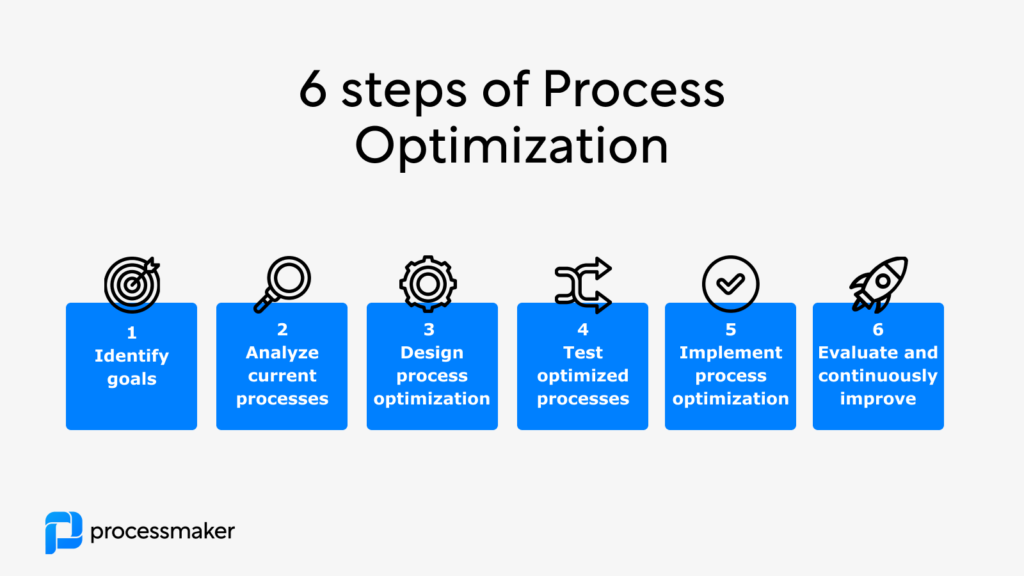
Figure 1. A framework for process optimization perhaps using information technology as the automation mechanism.
The improvement of manufacturing is hard. Armadas of consultants were deployed in the 1990’s to improve manufacturing productivity (using process analysis) in automated or partially automated systems, by slivers of percentage points (Six Sigma anyone?) . “Business Process Re-engineering” (“BPR”) was all the rage until the unfortunate (deliberate?) migration of much manufacturing activity outside of Western economies.
“Digital Transformation” is the new Black
“BPR” has re-emerged, rebranded as “digital transformation” in recent years across all sectors. However, the focus of these exercises should be more a fundamental recast of business activities, e.g. multi-channel sales, rather than solely a search for improvements in existing processes through automation. A fine distinction perhaps.
Something, sometime will go wrong. Oversight.
It is a reasonable premise that a provision for every material malfunction – “unconstrained exception-handling” – cannot be (theoretically?) practically engineered into any system “devoid of oversight”; a “person” to act beyond computation is required.
So to automate out completely the presence of a “person” would suggest there is no unacceptable “unexpected”. “Oversight” is not required. Ergo an automated taxi that travels with less than injurious energy is OK. Over that?
Does automation add up?
Given that oversight by a person(s) is a required component of a system then why spend money on automation?
If 80% of the work needed to deliver the desired output can be done with a “person included system” that costs 20% (analysis, design, build and maintain) of a “person devoid” system then a person is required to do the remaining 20% of the work, usually “exception-handling”.
Why can’t the person do the 80% as well? And do other work too?
Hence the ubiquity of the Excel proficient knowledge worker and the like in service sector offices.
Of course, if growth or other changes in business circumstance transpire then the equation can flex.
El Dorado or up the garden path?
Engaging in process optimization work may deliver but fool’s gold. Productivity can be improved, often by quite simple means – the improvement in the accuracy of a process, removing duplication, perhaps updating a key constituent component or service. On the other hand, an organisational psychosis can emerge e.g. obsessive benchmarking, that delivers only diminishing returns and which diverts scarce resources from other perhaps more vital activities like product development, marketing and sales. More dangerous still, focus is directed to the internal rather than on the external where existential risks can emerge.
What to make then of the “Automation” mania currently sweeping the service sector, driven by the hype of the “AI” free lunch.
Internet Productivity = Zipless; “AI” Productivity = Zipplus?
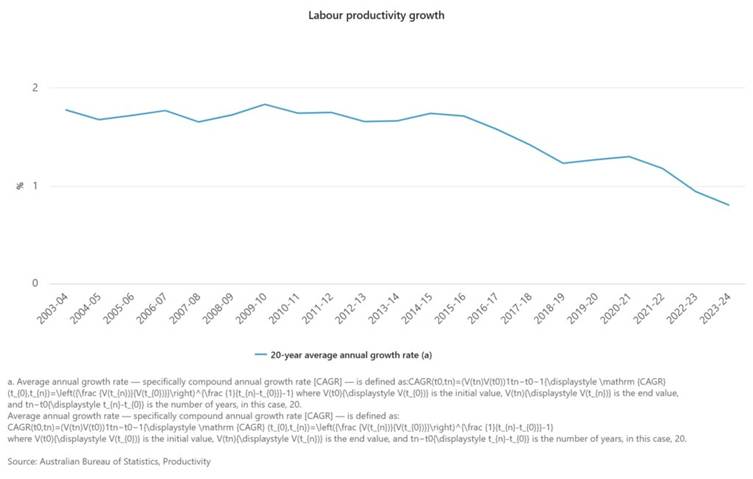
The above graph of Australian Labour Productivity since the turn of the millennium aligns approximately with the “internet age”. It is “pretty ordinary” as per the local vernacular.
This suggests that I.T. expenditure is approximately 5% of Australian GDP and it is suggested by the same source, Gartner, that this percentage will continue to increase. In the assumption that this category of expenditure has been 3%-4% percent of GDP over the period of interest (2003-2025) in Australia, it could be said that it is difficult to see how this expenditure has had a positive effect on wealth creation i.e. improved output per unit of input. Perhaps it has been acting against other frictions that have been working to reduce wealth creation. What might be those frictions? Are they generated by the previous systems (“tech debt” is the common expression) built by previous I.T. investment and accompanying practices?
It should be noted that it not just the Australian economy, as pointed out by Krugman and Gordon, in which productivity improvement from information technology investment is hard, if not impossible, to find.
Exceptions, on exceptions, on exceptions etc.
In the case study, the following is claimed:
“Month-end stress often traces back to a single operational truth: invoices that cannot post without human intervention. Exceptions stall payments, distort accruals, and absorb analyst time that should go to forecasting and vendor performance reviews.“
The article then explains how to reduce the impeding exceptions that militate the automation of the process. It might be sardonically observed:
The resources will never exist to perform this work (it will always be the last item on the backlog).
The initial work generates an outcome that demands further, continuous work thus cost and therefore little productivity improvement.
It is therefore probably easier and cheaper to employ somebody to tidy up the exceptions and therefore handle the entire process when not so occupied.
This case study well illustrates the potential false promise of productivity gains through I.T. investment in service sector activities. Consider:
Complex data-processing systems accrete “exception” conditions.
The cost of the removal and automated handling of “exceptions” exceeds the cost of tolerating the “exceptions”.
Overtime the data-processing systems “rot” through the accretion of exceptions and efforts to mitigate the effects of those exceptions; in competitive markets, an enterprise must respond or face the consequences. In the public sector or the regulated service sector, this process can continue effectively ad infinitum as the incentives for a reset solution do not exist. The organisation therefore becomes more inefficient as the rotting systems require more and more expense to maintain their functionality. Hence, productivity declines.
In addition, regulators insist on the introduction of new complexities into these rotting systems, which perhaps while justified, further add and entrench exceptions thus increasing the cost of outputs.
Easing Exceptions – an opportunity, a test for “AI”
What if there was a mechanism to eliminate the “exceptions” that bedevil rotting data-processing systems or significantly reduce the cost of maintenance of “exception handling” in those systems?
Is this an opportunity for “AI” technology and associated practice? Is “AI” really the step-change up from other available mechanisms as proponents claim?
Applied to the case study, the argument for “AI” is that a relatively inexpensive and pliable “AI” based function could be embedded in the invoice handling process to minimise the disruptive effect of malformed documents. This would enable the implementation of an automated system. Existing staff could be more gainfully employed and any growth in volumes handled by the automation without further expense.
The economics might suddenly work.
In this context, two methods exist to best examine opportunities within the organisation: cybernetics – to identify the complex data flows within systems and activity-based accounting to identify associated value and cost.
Pesky Customers – who needs ’em?
Figure 2. Customers, what customers?
Monopolists and oligopolists in the Australian economy e.g. Big Tech and banks, comfortable in their privileged market position, seem particularly tempted to outsource their customer interactions to “AI” technology.
If “AI” can handle most of the “exceptions” why bother with those outside the scope of such solutions? Let the customers step into line.
Given that exception conditions are particularly frequent at the interfaces between processes this tendency, from a cost perspective is understandable. However, an issue for regulators and boards of increasingly insular corporates, hidden from customers behind walls of technology in silos of groupthink will be whether “exceptional” customers and cases will continue to be worthy of attention.
Given that an organisation may wish to make an informed decision about their cyberdefence concerns, the following approach can deliver a coherent evaluation.
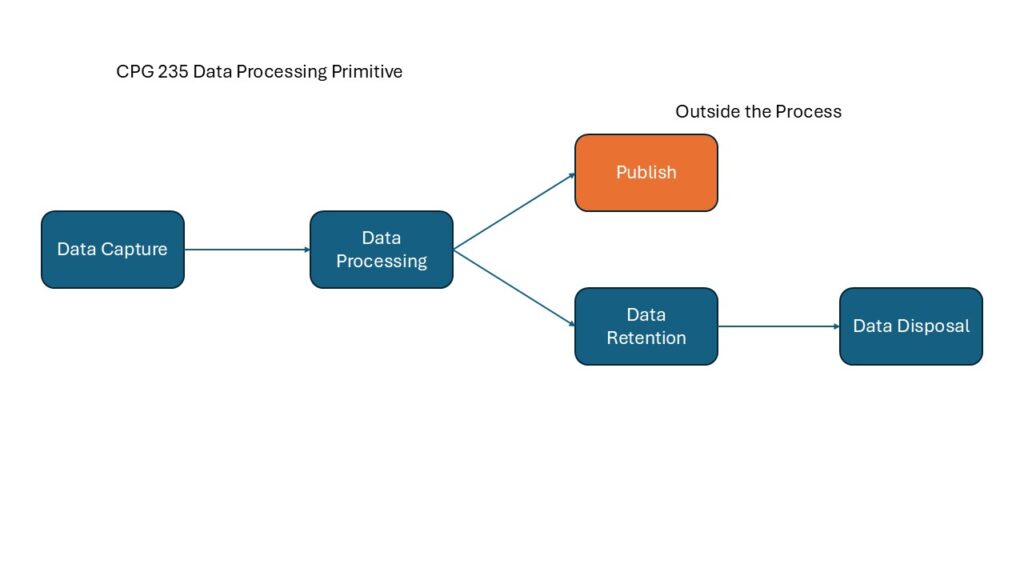
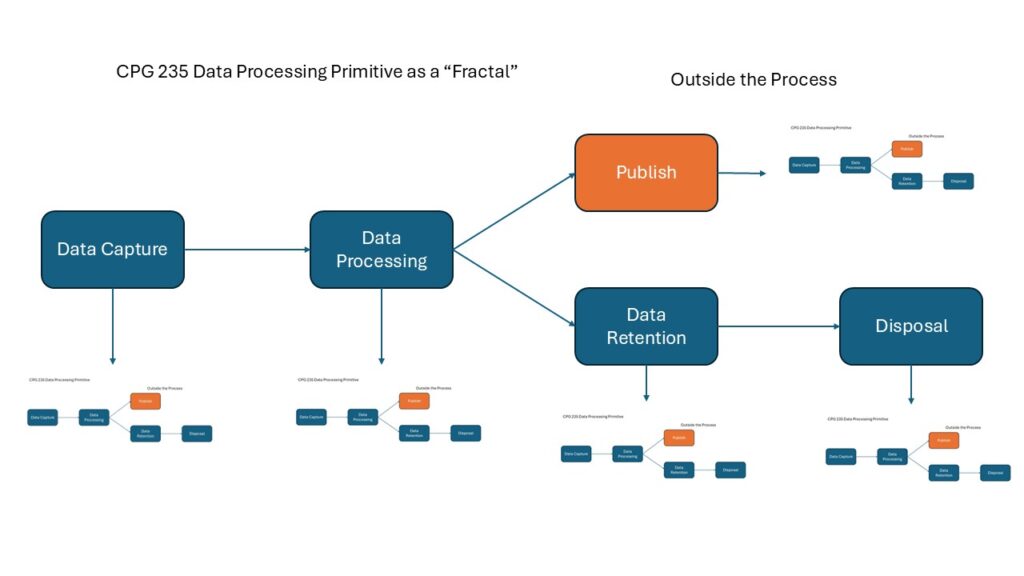
In the APRA practice guide, CPG 235, a “fractal” primitive of data processing is defined. This logical data-life cycle “primitive” suggests the following cybersecurity concepts:
Perimeter protection – a component of data-capture
Zero-trust – data processing, retention and publishing
Data Centric Security – data processing, retention and disposal given that publication suggests outputs beyond the domain into the data-capture of a related data process.
Figure 1. CPG 235 Data Processing “Fractal” PrimitiveFigure 2. CPG 235 Data Processing “Fractal” primitive, decomposed to the next level of resolution.
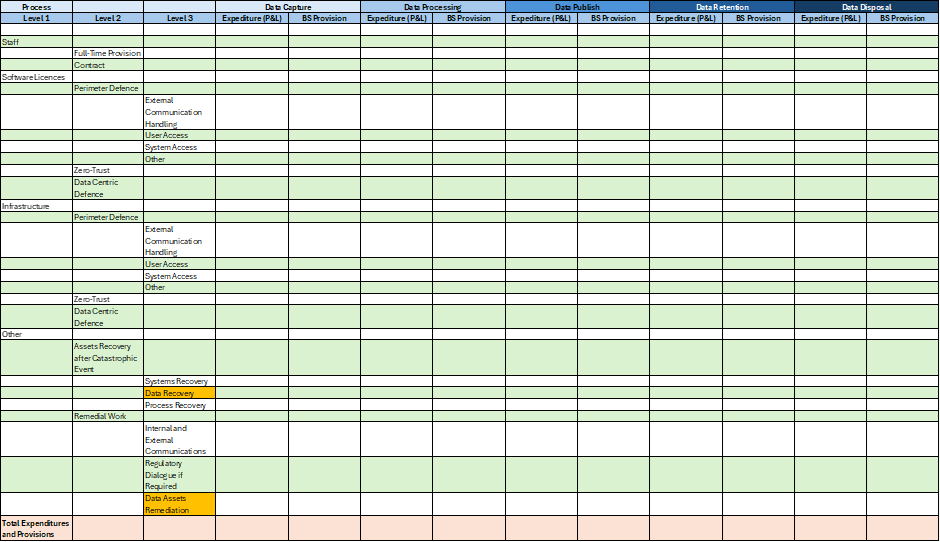
A simple business plan can be created for each “primitive”, described by cybernetic analysis estimating the cost of risk mitigation and the contingent provision required in the event of a catastrophic event. Some of the details required for this exercise may already be present as they are an output from other work e.g. privacy impact assessments.
Figure 3. Illustrative “business plan” with expenditure and provisions. Variables including time-scales, line-item detail can be adjusted as required by circumstances.
Expenditure in tooling and expertise etc. can then be allocated to the protection of these assets, the data processed and the supporting infrastructure, ranked by the cost of remediation of a catastrophic event.
Such existing sophistication or its elements already exist in many entities, for example, financial institutions but can be replicated or adapted to be of use in more modest circumstance. The analysis can be either as high or as low in resolution as required.
Through a focus on monetary values, matched to the charts of account or financial plans, the argument for cyberdefence investment can be made more easily to managerial colleagues from non-IT disciplines.
To complete the exercise, a test against contemporary jurisdictional regulation can be conducted through examination of the scheme of expenditure. Given that incidents will always occur, the question can be asked: “Is this a reasonable response that would be deemed a prudent act of stewardship when viewed by internal and external parties?”.
In conclusion
The outlined approach, where the questions “Why” and “What” are separated from the “How” enables an informed consideration and thus decision-making framework for the deployment of cyberdefence. Communication between management disciples is facilitated and measurable financial outcomes can be identified and subsequently evaluated for future refinement of the domain e.g. technology upgrade, process automation.