The problem with advertising is not that you waste half your money but that you don’t know which half.
The transition from “open loop” to “closed loop” media driven by clickbait-seeking stimuli in a cybernetic tsunami has lead to very unfortunate consequences.
In their analysis “Why Can’t AI Fix Social Media”, Chapter 6 of “AI Snake Oil” ISBN 9768-0-691-24914-8, Arvind Narayanan and Sayash Kapoor point out that the foul stench emanating from the social media sewer is not a technological problem but an existential problem.
The purpose of social media is to stink just enough to capture our attention but not too much to turn us away.
One is reminded of the quotation: “Taxation is the art of plucking the goose without making it squeal.”
It appears that the lesson learnt by the powers that be over the last twenty years of the clickbait curse is that the stench of fear is the stink most usefully deployed by the Skinner Box engine to pull in the cash.
It worked with Covid and now it seems that Frat Boy psychopaths in search of a quick buck are more than happy to parade their scary monsters before the cowering populace.
Three conversations with Sydney-based technology leaders last week all started the same way: “We’ve got AI tools, but they’re not moving the needle.”
Gareth Davies of research2.au invited Des, C-Suite/Executive Leader, currently an Engineering Delivery Executive at the Commonwealth Bank of Australia #CBA for a discussion on the 2026 challenges faced by his team and enterprise function in a large, extremely complex, highly-regulated and very visible institution.
In this, the first of three conversations, the “Why?” question is applied. Terms are defined in the general and the specific, the current state of play in #DevSecOps as the function is known at the #CBA is understood and the proposed solution introduced.
In the next two conversations, the “What” and “How” will be considered.
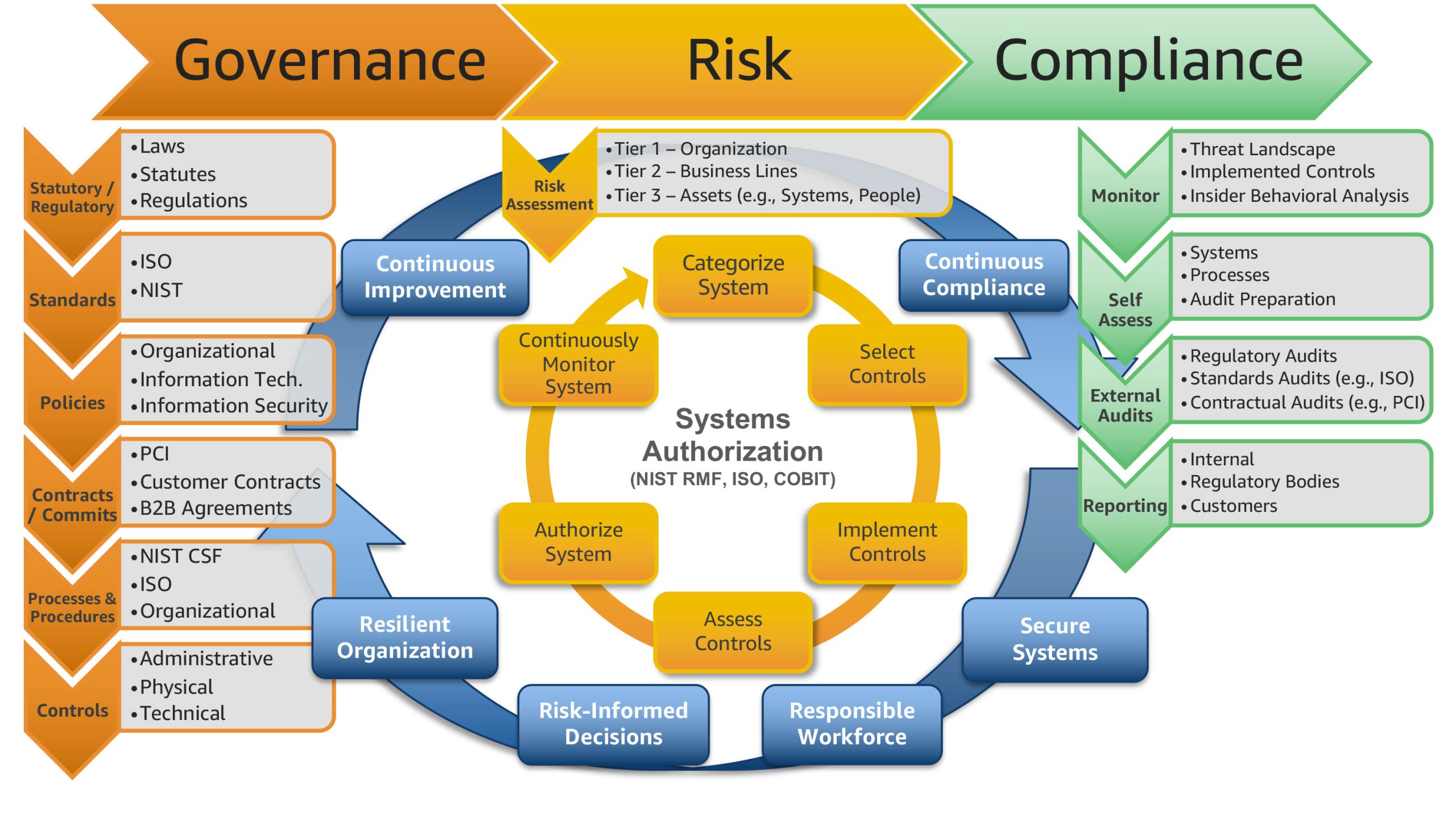
Who can afford governance when it looks like this?
Whither AI?
In the current mania, much conversation centres around the concept of “AI” governance?
Why? and what is “AI” governance? Now and in the future.
The issue is this. Even if “AI” tooling can be acceptably governed (if this can be defined) how much is this going to cost. Does the cost of governance (a “friction”) militate the use of “AI” as the benefits no longer outweigh the costs.
For example, in automated systems, an assumption might be that a given set of inputs will always generate a given set of outputs. A cake recipe when followed with fidelity will produce a cake. Is the respect of this principle a “core competence” of “AI” without significant investment in guardrails, audit etc.
The use of ISO Standards
It can be argued that a mechanism for a reasonable response to the use of new technologies is the adoption of ISO standards e.g. ISO27001 and for “AI” ISO42001, given that independent first principle analysis and deployment of requirements will be beyond the resources of most organisations.
A feature of “platform engineering” could be that compliance and governance functionality is available by default to engineers in their work.
In fact, one of the benefits of the adoption of “public cloud” platforms is the availability of default compliance functionality from the platform – for example in “privacy” – by the certified ISO handling of “personal data” or “personal information” as defined by the applied regulation. It is hard to envisage the circumstances in which a regulator would object to the reliance of a “public cloud” customer on a provider from the current “Big Tech” cohort.
Tendency to Oligopoly at Best
Current valuations for “AI” suggest that investors are betting on the identity of the eventual number one of one provider of “AI” services, given the enormous capital costs required for its deployment.
Equally, the complexities of “AI” deployment suggest that there will be a tendency towards at best an oligopoly of suppliers in the provision of governance, preferably systemised as a commodity.
Oligopoly profits and pricing privileges for “Big Tech” await, again, this time as an unintended consequence of regulation and governance.
How information technology has reduced productivity by the empowerment of bureaucratic and regulatory “busy-bodies”.
Example number 1: 50 years of finding a flat.
1976
Process Chain
Walk about, try to find real estate agent through fog of beer.
Visit a few places (in old mini) where undergraduate students (boys) are welcome – not many it must be said.
Sign up. Eye shotgun owned by landlord with suspicion.
Move in with lp’s, cassettes, bedding etc. in back of Dad’s (or somebody else’s Dad’s) car as mini too small.
Plug in electric bar heater, fix holes in bathroom window and break ice when needing shave.
Spend rent money on beer and cigarettes.
Summary
Time taken – couple of days. Experience – okay what do you expect? Paperwork – what’s that?
1986
Process Chain
Arrive at Tullamarine Melbourne, early morning January.
Spend morning at new job.
Go to Turnbull Cook on Toorak Road in South Yarra. Andrew shows us round a couple of whizzy flats.
Sign up. A few details printed on a dot matrix printer from their PC rental software (Peak productivity).
Move in. Duvet (doona) in plastic bag.
Spend rent money on rent.
Summary
Time taken – one day. Experience – fabulous. Paperwork – 10 minutes tops, pay with EFTPOS.
2026
Process Chain
Spend a week browsing through www.realestate.com.au, trying to get the saved searches right, fiddling with tens of parameters, sorting on various criteria. What fun. Better than smoking just.
Prepare applications – reams of personal information disclosure and uploading identity documents. What for? Busy-bodies.
Prepare program of visits, e-mails, texts, invites, flying all over. Print it out.
Turn up for viewings. Some very bizarre behaviour including taking a picture of a washing machine, the girlfriend in a wardrobe and getting in a panic when a door won’t open. #surftoserf
Sign up, pay up – huge bond and rent in advance.
Receive torrent of e-mails and texts about other properties and other things.
Delete all personal information a.s.a.p.
Move in.
Summary
Time taken – four or five days – do young people have to do this? Experience – bewildering. Paperwork? Piles of it.
The use of Information technology in the “internet age” has not delivered the wealth creation (measured by productivity improvement) prophesied by its evangelists. Yet expenditure on I.T. continues inexorably to rise. Can the introduction of “AI” better deliver value? “Yes” if it can it cut the cost of “Exception-handling” The following article from iTWire illustrates the point.
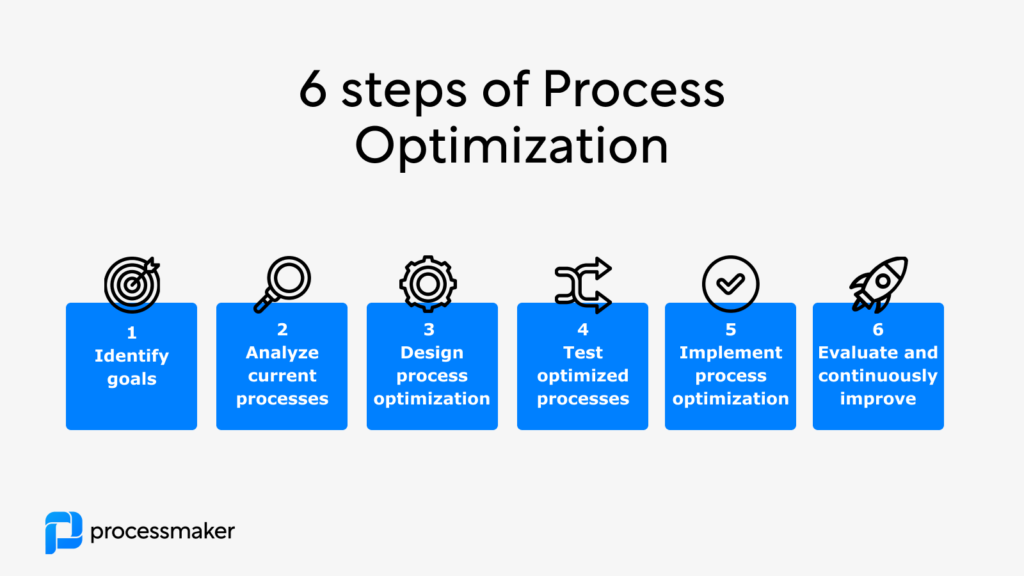
Figure 1. A framework for process optimization perhaps using information technology as the automation mechanism.
The improvement of manufacturing is hard. Armadas of consultants were deployed in the 1990’s to improve manufacturing productivity (using process analysis) in automated or partially automated systems, by slivers of percentage points (Six Sigma anyone?) . “Business Process Re-engineering” (“BPR”) was all the rage until the unfortunate (deliberate?) migration of much manufacturing activity outside of Western economies.
“Digital Transformation” is the new Black
“BPR” has re-emerged, rebranded as “digital transformation” in recent years across all sectors. However, the focus of these exercises should be more a fundamental recast of business activities, e.g. multi-channel sales, rather than solely a search for improvements in existing processes through automation. A fine distinction perhaps.
Something, sometime will go wrong. Oversight.
It is a reasonable premise that a provision for every material malfunction – “unconstrained exception-handling” – cannot be (theoretically?) practically engineered into any system “devoid of oversight”; a “person” to act beyond computation is required.
So to automate out completely the presence of a “person” would suggest there is no unacceptable “unexpected”. “Oversight” is not required. Ergo an automated taxi that travels with less than injurious energy is OK. Over that?
Does automation add up?
Given that oversight by a person(s) is a required component of a system then why spend money on automation?
If 80% of the work needed to deliver the desired output can be done with a “person included system” that costs 20% (analysis, design, build and maintain) of a “person devoid” system then a person is required to do the remaining 20% of the work, usually “exception-handling”.
Why can’t the person do the 80% as well? And do other work too?
Hence the ubiquity of the Excel proficient knowledge worker and the like in service sector offices.
Of course, if growth or other changes in business circumstance transpire then the equation can flex.
El Dorado or up the garden path?
Engaging in process optimization work may deliver but fool’s gold. Productivity can be improved, often by quite simple means – the improvement in the accuracy of a process, removing duplication, perhaps updating a key constituent component or service. On the other hand, an organisational psychosis can emerge e.g. obsessive benchmarking, that delivers only diminishing returns and which diverts scarce resources from other perhaps more vital activities like product development, marketing and sales. More dangerous still, focus is directed to the internal rather than on the external where existential risks can emerge.
What to make then of the “Automation” mania currently sweeping the service sector, driven by the hype of the “AI” free lunch.
Internet Productivity = Zipless; “AI” Productivity = Zipplus?
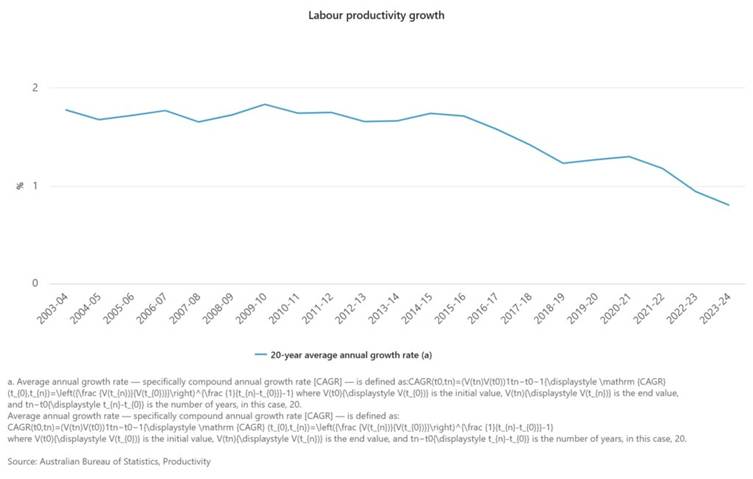
The above graph of Australian Labour Productivity since the turn of the millennium aligns approximately with the “internet age”. It is “pretty ordinary” as per the local vernacular.
This suggests that I.T. expenditure is approximately 5% of Australian GDP and it is suggested by the same source, Gartner, that this percentage will continue to increase. In the assumption that this category of expenditure has been 3%-4% percent of GDP over the period of interest (2003-2025) in Australia, it could be said that it is difficult to see how this expenditure has had a positive effect on wealth creation i.e. improved output per unit of input. Perhaps it has been acting against other frictions that have been working to reduce wealth creation. What might be those frictions? Are they generated by the previous systems (“tech debt” is the common expression) built by previous I.T. investment and accompanying practices?
It should be noted that it not just the Australian economy, as pointed out by Krugman and Gordon, in which productivity improvement from information technology investment is hard, if not impossible, to find.
Exceptions, on exceptions, on exceptions etc.
In the case study, the following is claimed:
“Month-end stress often traces back to a single operational truth: invoices that cannot post without human intervention. Exceptions stall payments, distort accruals, and absorb analyst time that should go to forecasting and vendor performance reviews.“
The article then explains how to reduce the impeding exceptions that militate the automation of the process. It might be sardonically observed:
The resources will never exist to perform this work (it will always be the last item on the backlog).
The initial work generates an outcome that demands further, continuous work thus cost and therefore little productivity improvement.
It is therefore probably easier and cheaper to employ somebody to tidy up the exceptions and therefore handle the entire process when not so occupied.
This case study well illustrates the potential false promise of productivity gains through I.T. investment in service sector activities. Consider:
Complex data-processing systems accrete “exception” conditions.
The cost of the removal and automated handling of “exceptions” exceeds the cost of tolerating the “exceptions”.
Overtime the data-processing systems “rot” through the accretion of exceptions and efforts to mitigate the effects of those exceptions; in competitive markets, an enterprise must respond or face the consequences. In the public sector or the regulated service sector, this process can continue effectively ad infinitum as the incentives for a reset solution do not exist. The organisation therefore becomes more inefficient as the rotting systems require more and more expense to maintain their functionality. Hence, productivity declines.
In addition, regulators insist on the introduction of new complexities into these rotting systems, which perhaps while justified, further add and entrench exceptions thus increasing the cost of outputs.
Easing Exceptions – an opportunity, a test for “AI”
What if there was a mechanism to eliminate the “exceptions” that bedevil rotting data-processing systems or significantly reduce the cost of maintenance of “exception handling” in those systems?
Is this an opportunity for “AI” technology and associated practice? Is “AI” really the step-change up from other available mechanisms as proponents claim?
Applied to the case study, the argument for “AI” is that a relatively inexpensive and pliable “AI” based function could be embedded in the invoice handling process to minimise the disruptive effect of malformed documents. This would enable the implementation of an automated system. Existing staff could be more gainfully employed and any growth in volumes handled by the automation without further expense.
The economics might suddenly work.
In this context, two methods exist to best examine opportunities within the organisation: cybernetics – to identify the complex data flows within systems and activity-based accounting to identify associated value and cost.
Pesky Customers – who needs ’em?
Figure 2. Customers, what customers?
Monopolists and oligopolists in the Australian economy e.g. Big Tech and banks, comfortable in their privileged market position, seem particularly tempted to outsource their customer interactions to “AI” technology.
If “AI” can handle most of the “exceptions” why bother with those outside the scope of such solutions? Let the customers step into line.
Given that exception conditions are particularly frequent at the interfaces between processes this tendency, from a cost perspective is understandable. However, an issue for regulators and boards of increasingly insular corporates, hidden from customers behind walls of technology in silos of groupthink will be whether “exceptional” customers and cases will continue to be worthy of attention.