
The use of Information technology in the “internet age” has not delivered the wealth creation (measured by productivity improvement) prophesied by its evangelists. Yet expenditure on I.T. continues inexorably to rise. Can the introduction of “AI” better deliver value? “Yes” if it can it cut the cost of “Exception-handling” The following article from iTWire illustrates the point.
Eliminating Exceptions in Procurement Processes
Process Automation Yes or No?
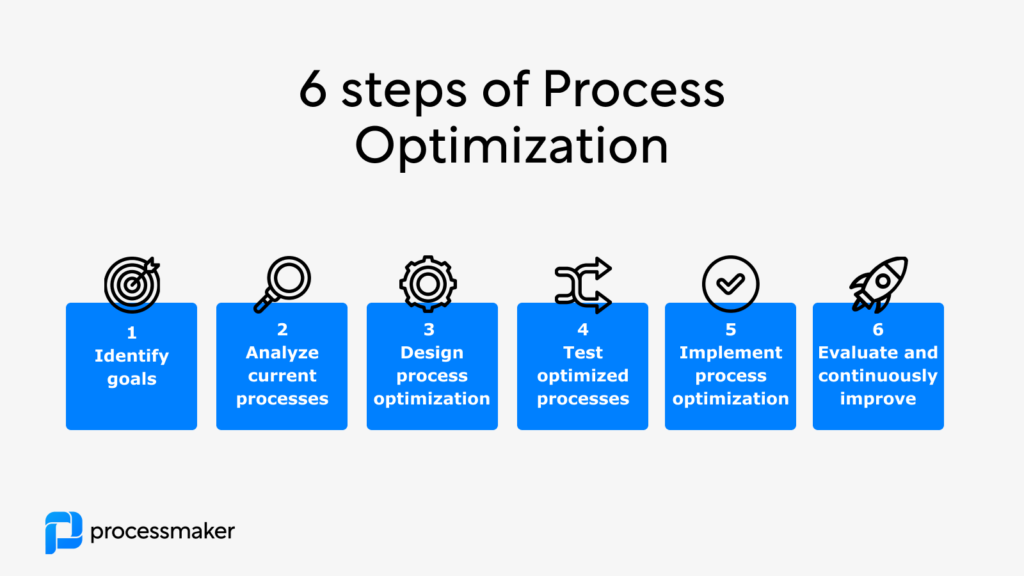
The improvement of manufacturing is hard. Armadas of consultants were deployed in the 1990’s to improve manufacturing productivity (using process analysis) in automated or partially automated systems, by slivers of percentage points (Six Sigma anyone?) . “Business Process Re-engineering” (“BPR”) was all the rage until the unfortunate (deliberate?) migration of much manufacturing activity outside of Western economies.
“Digital Transformation” is the new Black
“BPR” has re-emerged, rebranded as “digital transformation” in recent years across all sectors. However, the focus of these exercises should be more a fundamental recast of business activities, e.g. multi-channel sales, rather than solely a search for improvements in existing processes through automation. A fine distinction perhaps.
Something, sometime will go wrong. Oversight.
It is a reasonable premise that a provision for every material malfunction – “unconstrained exception-handling” – cannot be (theoretically?) practically engineered into any system “devoid of oversight”; a “person” to act beyond computation is required.
Generative AI has it already peaked – Computerphile
So to automate out completely the presence of a “person” would suggest there is no unacceptable “unexpected”. “Oversight” is not required. Ergo an automated taxi that travels with less than injurious energy is OK. Over that?
Does automation add up?
Given that oversight by a person(s) is a required component of a system then why spend money on automation?
If 80% of the work needed to deliver the desired output can be done with a “person included system” that costs 20% (analysis, design, build and maintain) of a “person devoid” system then a person is required to do the remaining 20% of the work, usually “exception-handling”.
Why can’t the person do the 80% as well? And do other work too?
Hence the ubiquity of the Excel proficient knowledge worker and the like in service sector offices.
Of course, if growth or other changes in business circumstance transpire then the equation can flex.
El Dorado or up the garden path?
Engaging in process optimization work may deliver but fool’s gold. Productivity can be improved, often by quite simple means – the improvement in the accuracy of a process, removing duplication, perhaps updating a key constituent component or service. On the other hand, an organisational psychosis can emerge e.g. obsessive benchmarking, that delivers only diminishing returns and which diverts scarce resources from other perhaps more vital activities like product development, marketing and sales. More dangerous still, focus is directed to the internal rather than on the external where existential risks can emerge.
What to make then of the “Automation” mania currently sweeping the service sector, driven by the hype of the “AI” free lunch.
Internet Productivity = Zipless; “AI” Productivity = Zipplus?
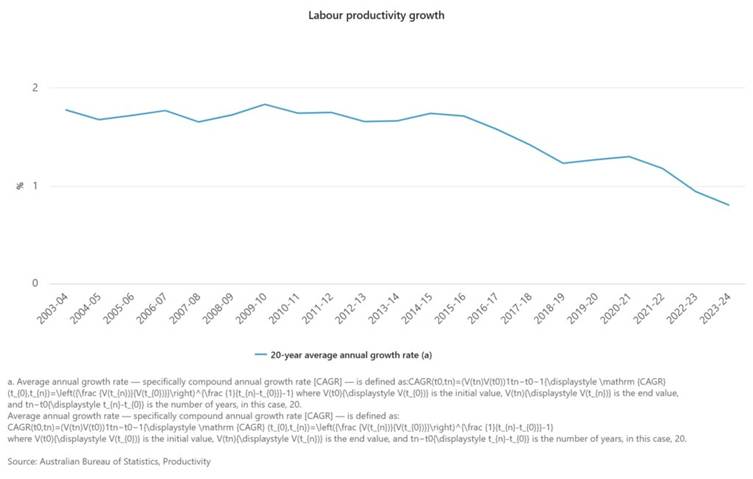
The above graph of Australian Labour Productivity since the turn of the millennium aligns approximately with the “internet age”. It is “pretty ordinary” as per the local vernacular.
Australian GDP in 2025 is approximately AUD2.7 trillion per annum in the year 2024 to 2025. Gartner estimated that I.T. expenditure in the Australian economy in 2025 to be AUD147 billion.
This suggests that I.T. expenditure is approximately 5% of Australian GDP and it is suggested by the same source, Gartner, that this percentage will continue to increase. In the assumption that this category of expenditure has been 3%-4% percent of GDP over the period of interest (2003-2025) in Australia, it could be said that it is difficult to see how this expenditure has had a positive effect on wealth creation i.e. improved output per unit of input. Perhaps it has been acting against other frictions that have been working to reduce wealth creation. What might be those frictions? Are they generated by the previous systems (“tech debt” is the common expression) built by previous I.T. investment and accompanying practices?
It should be noted that it not just the Australian economy, as pointed out by Krugman and Gordon, in which productivity improvement from information technology investment is hard, if not impossible, to find.
Exceptions, on exceptions, on exceptions etc.
In the case study, the following is claimed:
“Month-end stress often traces back to a single operational truth: invoices that cannot post without human intervention. Exceptions stall payments, distort accruals, and absorb analyst time that should go to forecasting and vendor performance reviews.“
The article then explains how to reduce the impeding exceptions that militate the automation of the process. It might be sardonically observed:
- The resources will never exist to perform this work (it will always be the last item on the backlog).
- The initial work generates an outcome that demands further, continuous work thus cost and therefore little productivity improvement.
- It is therefore probably easier and cheaper to employ somebody to tidy up the exceptions and therefore handle the entire process when not so occupied.
This case study well illustrates the potential false promise of productivity gains through I.T. investment in service sector activities. Consider:
- Complex data-processing systems accrete “exception” conditions.
- The cost of the removal and automated handling of “exceptions” exceeds the cost of tolerating the “exceptions”.
- Overtime the data-processing systems “rot” through the accretion of exceptions and efforts to mitigate the effects of those exceptions; in competitive markets, an enterprise must respond or face the consequences. In the public sector or the regulated service sector, this process can continue effectively ad infinitum as the incentives for a reset solution do not exist. The organisation therefore becomes more inefficient as the rotting systems require more and more expense to maintain their functionality. Hence, productivity declines.
- In addition, regulators insist on the introduction of new complexities into these rotting systems, which perhaps while justified, further add and entrench exceptions thus increasing the cost of outputs.
Easing Exceptions – an opportunity, a test for “AI”
What if there was a mechanism to eliminate the “exceptions” that bedevil rotting data-processing systems or significantly reduce the cost of maintenance of “exception handling” in those systems?
Is this an opportunity for “AI” technology and associated practice? Is “AI” really the step-change up from other available mechanisms as proponents claim?
Applied to the case study, the argument for “AI” is that a relatively inexpensive and pliable “AI” based function could be embedded in the invoice handling process to minimise the disruptive effect of malformed documents. This would enable the implementation of an automated system. Existing staff could be more gainfully employed and any growth in volumes handled by the automation without further expense.
The economics might suddenly work.
In this context, two methods exist to best examine opportunities within the organisation: cybernetics – to identify the complex data flows within systems and activity-based accounting to identify associated value and cost.
Pesky Customers – who needs ’em?

Monopolists and oligopolists in the Australian economy e.g. Big Tech and banks, comfortable in their privileged market position, seem particularly tempted to outsource their customer interactions to “AI” technology.
The CBA recently took a bloody nose on “AI” in the customer interface with an ill-conceived lurch.
If “AI” can handle most of the “exceptions” why bother with those outside the scope of such solutions? Let the customers step into line.
Given that exception conditions are particularly frequent at the interfaces between processes this tendency, from a cost perspective is understandable. However, an issue for regulators and boards of increasingly insular corporates, hidden from customers behind walls of technology in silos of groupthink will be whether “exceptional” customers and cases will continue to be worthy of attention.
Who will fight for the little guy?
Further Reading
ABS GDP Statistics September Quarter 2025
ABS National Accounts 2024-2025 Key tables
CSIRO – Does AI actually boost productivity?
To read the following, you will be best advised to take out a N.Y.T subscription.
The Internet was an Economic Disappointment
Paul Krugman Reviews ‘The Rise and Fall of American Growth’ by Robert J. Gordon
#cybernetics #activitybasedaccounting #digitaltransformation #businessprocessreengineering
Leave a Reply