
Contents
c. Analysis to be Performed. 3
2. Critical Review of the Chosen Methods. 4
c. Critical Systems Heuristics. 9
1. Research Proposal
a. Introduction
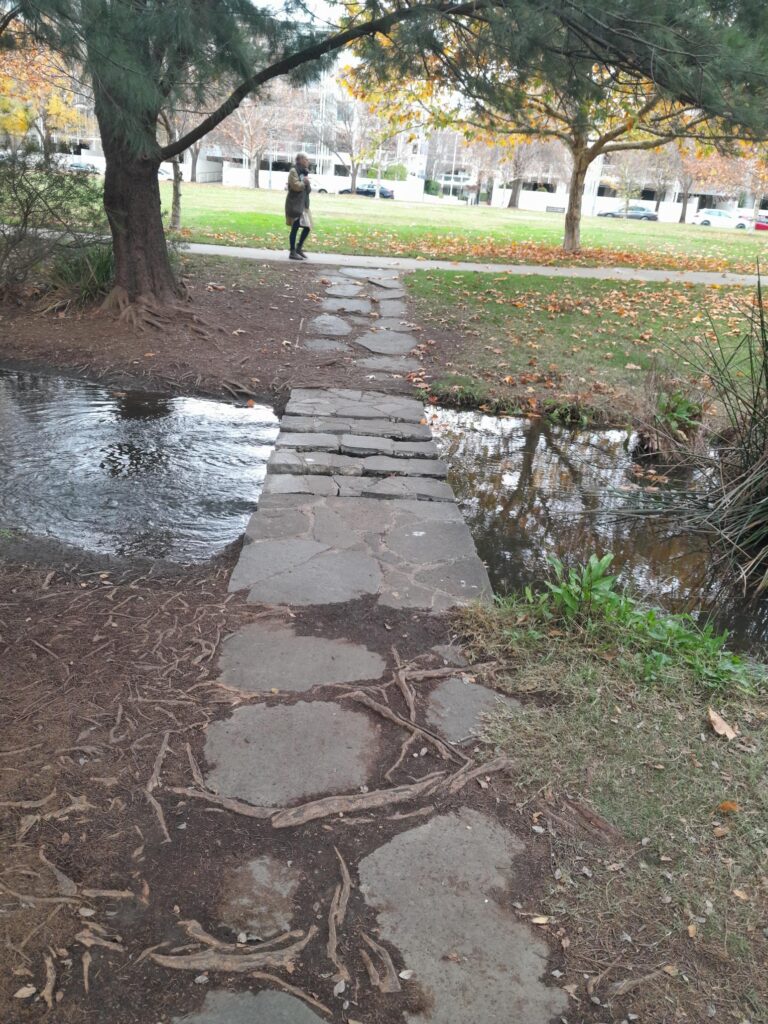
Three constructions in the ACT are the focus of the Research Proposal (“RP”). Two are located on the campus of the ANU in the ACT, the Birch Building and the ford (a.k.a. “magic stones”) built out of concreted, sandstone pieces across Sullivan’s Creek near the Sports Gym. The third construction is another ford, built in Norgrove Park, in Kingston, an inner-south suburb of Canberra. Photographs of the three constructions are presented in Appendix A.
The first idea was to consider the Birch Building and the “magic stones”. The former, the home of the ANU School of Cybernetics is of a form of particular interest to the author (Grindrod, 2014). It appears to have been conceived as proudly modernist and although much effort seems to have been spent, to this eye, successfully, in softening the “brutalist” thesis, there appears little about the work that says “Australia”. In contrast, the “magic stones” are an intriguing presence, at once nostalgic for the “Fairies and Wizards” of the imagined rural arcadia of England[1] (MacKellar, 1908) (Lawrence, 2007) (Hitchins, 2003) yet respectful of the nature of the Australian watercourse, capricious, once a trickle and now a flood[2]. This juxtaposition of themes, perhaps common to all things expressed by the exile[3], the arcadian perhaps more explicitly seen, is replicated in the garden of Norgrove Park by the ford across the stream. A pleasing contrast to the unpleasant congregation of poorly crafted apartments that occupy the vicinity this construct has been brought into the analysis to further inform. Is it a Canberra thing? An ANU thing? There are many functional examples of this type of construction to explore in Australia, for example on and around the Nattai Creek in the Southern Highlands of NSW.
The “RP” seeks in the first instance to understand:
- The interactions between the individual constructions and the ecosystems primarily but not exclusively people with which they engage either directly or indirectly.
- The interactions that in concert with the other buildings and objects that populate their milieu both built and natural apply as per in 1.;
- How can the two sets of interactions be understood as separate and individual and whether they act together in some cybernetic sense.
- The ambition of each construction is very different but that is the point. The status of each construction can be judged against the ambition of the individual construction, the constructions in comparison and the constructions acting together. How have they fared?
- Finally, it would be valuable to determine whether an “RP” of this nature can provide useful support for future endeavours in the built environment, in particular in the ACT.
b. Methodologies
The following methodologies have been chosen for use in the “RP”:
- Actor Network Theory “ANT” (Birkbak, Forthcoming)
- Semiotics (Eco, Introduction: Toward a Logic of Culture, 1976)
- Critical Systems Heuristics (“CSH”) (Ulrich, 2005)
It is envisaged that the analysis activity will be performed using “ANT” (2) and Semiotics (3). “CSH” (1) will be used to monitor the process and findings of the other two methods and to support an internal debate; a mechanism so to say of self-regulation.
c. Analysis to be Performed
The initial questions in an organisational analysis are commonly “Why”, “What” and “How” applied to the current state; future states are then conjectured, some more acceptable to the prevailing imperatives than others, sometimes optimistically labelled “success”. Various paths to these enticing visions are then described.
In this case, the current state is to be that prior to the commencement of these constructions. The future state can now be seen for appraisal.
Why do these constructions exist? The proposal is that an examination using “ANT” across the processes e.g. conception, planning, construction that built the constructions, will enable an understanding of the purposes that brought them into being and inform a comparison of purposes across the constructions. Agent and actor nets in combinations of perspectives, configurations and dimensions e.g. time will be considered.
Semiotics will then be used to examine the means by which these purposes were created through the communications within and between the nets. This is expected to be an iterative and recursive process feeding back into the “ANT” exercise in a cybernetic effect (Wiener, 1950).
It is not inconceivable that there were a number of variations in and interpretations of, the purposes extant within the various networks, that were contradictory or in conflict and that deceptions, illusions (self or otherwise) and intrigue worked either explicitly or in some unconscious manner to deliver the resultant outcomes. For example, how did the various university, ACT and Australian governance and management agencies engage? Within and between themselves and the practitioner industry sectors that were to build the constructions. How did the identified networks work to convey and prosecute their intent?
What are these constructions?
The intention is to use “ANT” to describe the contemporary constructions (our “future state”) and the relationships that exist between the actors and agents that manifest as nodes within and external to the constructions themselves.
The challenge will be to introduce a third dimension, time, into network definition as the “What” of the constructions has changed over the years of their existence. Buildings age and thus require maintenance (as per any other facility) that may change some aspect of their influence. For example, the Birch Building has been refurbished and repurposed to reflect more contemporary institutional ambitions. They can also acquire status and reverence from their participation in the life of their community.
How do these constructions achieve their effects?
“How” considers the methods by which the constructions interact with the surroundings both internal and external and ecosystems (people, creatures, plants) with which they engage. How do these constructions play a role in the “Sensoria” that constitute the campus of the ANU and the locale of Norgrove Park through the transmission and reception of messages.
Semiotics presumes to describe the meaning and effect of the messages (Weaver, 1949)). The “RP” proposes that this mode of thought be used to understand the messages that constitute the ties of influence that bind the network nodes identified by “ANT”.
Are these messages a deliberate and conscious intention of the creators of the constructions or a derivative of the features and function that emerged unforeseen from the delivered work and subsequent physical and cultural maturation. How has subsequent development of the two locations (ANU Campus and Norgrove Park) amended these methods of influence and subsequently been influenced by them.
2. Critical Review of the Chosen Methods
In the “Critical Review” the “fitness-for-purpose” of the methodologies for the analysis to be performed is considered.
a. Actor Network Theory
The following discussion of “ANT” is informed by the readings and exercises engaged in Dr. Perriam’s class in CYBN6001[4] (Birkbak, Forthcoming) and the CYBN6001 lecture on Network Mapping[5]. The ontogeny of “ANT” is not considered rather the pragmatic use of “ANT” or constituents of “ANT” in the service of the “RP”.
Rather like “cybernetics” itself “ANT” does not appear to be easily defined nor therefore constrained. For this “RP”, “ANT” will be used as a paradigm in which there is an intent, a suggested mode of thought and consequent activity designed to achieve that intent.
An ambition of the “RP” is that as many perspectives as possible are considered in the examination of the constructions and their creation, without constraint and impaired by assumptions. This examination is to be guided by the “ANT” concepts of “agent” and “actor” that describe the nodes in the networks of influence in which the constructions are deemed to exist or have existed. By the documentation and exploration of the relationships between the nodes and their nature, the premise is that a truer understanding of the constructions, can be found.
For our purpose, an “agent” is an entity (without constraint of form) that can make a decision about their influence on the relationships in a network and that an “actor” is a mechanism for the application of that agency. An individual node maybe an agent and an actor, in which case the node may require further decomposition. A simple or complex series of actor nodes may deliver the influence of an agent. The boundaries of a network may be seen by the diminution of influence of the agents within, like decaying ripples on a pond as they disappear from view; the point of disappearance, the influence horizon, is probably the point.
This approach is not unlike that of systems data-analysis when the focus is on the information flows (or data flows depending on the nomenclature (Gane & Sarson, 1979)) within the life-cycle of the system (the basis of the privacy assessment process as recommended by the OAIC[6]). Where do these flows start and end? It is perhaps not coincidence that the technique of data-analysis and “ANT” appear to gain traction in the late 1970’s to early 1980’s.
A question is now one of boundary, referring back to the extent of influence of agency. In data-analysis there is the presence of a temporal dimension as in data-flows (maybe in series and/or concurrent). The extension of the boundary to a third-dimension, that of time, seems to be a necessary addition to the usefulness of “ANT”, especially given the period over which the constructions have existed. If a construction is seen as a set of interlocking networks over time, these networks could then be visualized and examined by rotation through longitudinal and horizontal dimensions as in a model of a protein.
A second point: data-flow analysis over the life-cycle of a system can often reveal a “neo-fractal” state, whereby at each instance of a data-transformation, further analysis reveals a set of “lower level” of systems, with their own data-flows and transformations. It is possible to conceive of a similar effect when documenting networks. For example, a high-level network in the conception of a construction may describe regulators, architects and structural engineers each of which can be described by its own set of networks populated by agents and actors.
At any given time, there will be an initial analysis position with conjected sets of easily construed relationships acting in various proximities. How will the more nebulous then be discerned? As previously discussed, there may be a temporal dimension too so that the atomic primitive of any “ANT” analysis might be seen as a “basket”[7], a 3D lattice or perhaps a tube of coiled inter-connections of “variable” strength to represent the changing influences that act on and in the system of consideration; a congregation of cybernetic processes in train. The “variability” of these connections can be represented by the use of adjustable weightings as per Graph Theory[8]. These primitives can then be manipulated and combined in a process of review. The result of a review could then constitute the initial position of the next iteration of review or an agreed impression for a concluding commentary.
As can be imagined from the previous paragraph, the primary practical concern in the use of the “RP” “ANT” paradigm is that the volume of data acquired and the consequent creation of sets of networks will lead to an unduly complicated and unwieldy set of artefacts. The impression is that these artefacts may demand the use of an emerging technology e.g. “AI” to be fully examined given the intention is to inform as much as possible the evaluations central to the “RP”.
While there is an intention to use “ANT” to create as comprehensive a “body of knowledge” as possible to support the interpretation of the constructions and their effects, there is a limit. Something inconsequential or not, who knows, will always be omitted from the data collection and then during the analysis process, decisions will have to be made to omit data from consideration; there is not enough resource to spend on its analysis. How is this to be done, to maximise the fidelity to “open-mindedness” in a process of “reasonable judgement”?
The suggestion is that “reasonable judgement” should be informed by the “CSH” framework, one of the methods under review. The true worth of this framework will of course only emerge in use. What questions should be asked during the analysis to minimise any omission of consequential data and to avoid the cliched, myopic and complacent.
b. Semiotics
The reference text for this section is the book by Umberto Eco “The Theory of Semiotics” 1976, Indiana University Press.
Eco’s ambition in this original work is quite extraordinary as described in the introduction of that book. Equally extraordinary would be to attempt a demonstration of an understanding of the entirety of subject in this discussion.
In the alternative, consider the application of semiotic theory in the “RP” to answer the “How” of the interactions with the environment and ecosystem of the constructions. Where are the boundaries? Already a cybernetic relationship (Wiener, 1950) between the two questions is established as the “What” depends on the “How” that then influences the “What” as boundary identification is determined by influence through immediate and derived effects.
Warren Weaver in his introduction (Weaver, 1949) describes three levels of communication problem and the relationship between them:
“Level A. How accurately can the symbols of communication be transmitted?
Level B. How precisely do the transmitted symbols convey the desired meaning?
Level C. How effectively does the received meaning affect conduct in the desired way?”
The work of Shannon is concerned with “Level A”, leaving “Level B” and “Level C” to the province of semiotics, taken up by Eco, published in his book three decades or so later.
The significance of the “actor agent” debate in the “ANT” to Weaver’s “Problems in Communication” (or vica versa) is immediately clear by reference to Level B. and Level C. described by Weaver as “semantic” and “effectiveness” respectively.
Weaver’s phrase, “symbols of communication” is an excellent description of “data” as it does not prescribe form, nor presence or absence as a defining characteristic. This abstraction is the “primitive” for communication in the solution of the Level A, the “technical” problem as addressed by Shannon (Shannon, 1949).
In a similar fashion, Eco seeks at the first opportunity in his book to identify the semantic primitive in his elementary communication model (Eco, Signification and Communication, 1976) in an emulation of Weaver and Shannon (Weaver, 1949). There is no cause to prescribe the physical nature of the semiotic primitive, it can remain an abstraction. Further, he seeks to separate as Weaver had done, the engineering from the meaning and effect through the definition of signal and sign the former a concept in Level A., the latter in Level B and in Level C.
C.S. Peirce turns up in Page 15 (Eco, Introduction: Toward a Logic of Culture, 1976) (He will be seen in “CSH”; a small world?):
“By semiosis I mean an action, an influence, which is or involves, a cooperation of three subjects, such as a sign, its object and interpretant, this tri-relative influence not being in any way resolvable into actions between pairs”.
The premise is that the basic primitives of semiotic communication as described by Peirce and Eco can be used to understand the creation by communication, of patterns of influence around the “ANT” network sets by which the constructions have been defined.
To start: an easily understood example, the primary material of construction. How does it communicate? What are its signs?
For the Birch Building, there is concrete, the “magic stones”, sandstone and for the ford in Norgrove Park? T.B.D. Even this apparently uncomplicated characteristic immediately engenders an explosion of messages for consideration. For example, universities in Australia and the UK for example are accorded status and categorised by reference to primary building material of their construction – “Sandstone”, “Redbrick”, “Plate Glass” etc. The monumental nature of the task of analysis of messages across the potential networks of influence, the modulation of those messages by the constituent nodes and the consequences fed back into the networks by those messages is staggering.
c. Critical Systems Heuristics
The premise is that the “CSH” framework can be used to “oversee” the other two methods “ANT” and semiotics used in the “RP”. Werner Ulrich in (Ulrich, 2005) offers an introduction to the “CSH” framework. Sections of this work are referenced throughout this text.
In “CSH”, Ulrich appears concerned with the creation of a method for the oversight of deliberation – “reflective practice”; so far so good. The main point appears to be that outcomes of deliberations will be improved if they are not unduly constrained; this is, it might be argued from personal experience, quite optimistic even if it is a notion ever accepted by the participants.
No doubt, there is a political motivation for this venture; he hopes for the participation of “ordinary people” in “reflective practice”. Perhaps he should have used “CSH” to reflect on the meaning of his separation of people into the categories of “ordinary” and “non-ordinary”. Fortunately, this political dimension is not a concern of the “RP”.
Our question (using “CSH” to evaluate “CSH”?) is whether a “reasonable judgement” would be that “CSH” is fit-for-purpose for its work within the “RP”, that is to say, enable a reliable and replicable “reflective practice”.
The required elements appear to be within the framework.
- The concern is with reflection, critique, appraisal; this is the purpose for “CSH” within the “RP”.
- That “questioning” and debate are the tools by which reflection is manifested. The term “heuristics”, in the name of the approach, is derived from the Greek, to find and discover. The “RP” is an exploratory exercise seeking answers to questions as yet unformed.
- A critical approach is required; What does this mean? Surely, that is the nature of reflection. A reflection that does not offer a critique is not a reflection. A critique may offer nothing of interest, indeed nothing at all but its presence is the evidence of reflection.
- This “reflection” is to be applied to the systems as understood by the “ANT” and semiotic methods employed in the RP”. Ulrich focuses on the “boundary” issue – when and where does the system end?
The result of “CSH” activity appears to be a “reference system” that defines a claim to be deliberated. How is this “reference system” to be tested to be of value?
Two other frameworks for the resolution of claims are worth of scrutiny although of course no suggestion is made that these frameworks are in practice, immune to distortion and corruption.
In scientific work, according to Popper (Magee, 1975), a falsifiable claim (hypothesis) is required for the next potential step in the path to understanding the world. If the claim is not falsifiable then it is by definition not a scientific claim but one of belief or faith. The process of falsification must be a replicable exercise, usually understood as “scientific method” (usually the performance of a replicable controlled experiment). The process is incremental and cybernetic, in that a falsifiable claim may be discarded or alternatively adjusted and fed back for consideration prior to further experiment. If the falsifiable claim cannot be falsified, then it stands as scientific understanding until it is falsified. There is no concept of “proof”.
There is reference by Ulrich to scientific work; he refers to the presence of the “pragmatic maxim” within, derived from the work of Charles Peirce in 1878 that describes the empirical nature of the scientific process.
In an adversarial court, where the burden of proof lies with the prosecution, tests are applied to assertions supported by evidence, to attempt the establishment of an objective reality that can be judged against the criteria of assessment of the court. This exploration may be a combination of falsifications or an elimination of possibilities. For example, “proof” requires that all the falsifiable claims brought to the court cannot be rebutted. For example, if every claim brought by a prosecution has not been rebutted except the claim that the alleged perpetrator was at the scene of the crime then a state of “proof” has not been created by the prosecution.
Equally, as every schoolboy once knew “When you have eliminated the impossible, whatever remains, however improbable, must be the truth.” (Conan-Doyle, 1890).
It appears to this reader, that the “CSH reference system” to which attention is to be given is more amorphous and “woolly” than found in scientific work and the court. Perhaps this reflects the both the nature of the issues with which, according to Ulrich (Ulrich, 2005) its practitioners might be concerned and the form and context of the anticipated deliberation. Open questions such as “Who benefits?” and “What is improvement?” are intensely political and can be subject to a multitude of interpretations, generally more so than those considered in the scientific frame and at the conclusion of the formal processes of the court.
The “CSH” “reference system” appears a similar notion to the falsifiable claim demanded by the scientific process. Therefore, the evaluation of “reference systems” might be simplified from that described by Ulrich (Ulrich, 2005) to a set of “tests” that can be applied to claims expressed as “reflection systems”. As Ulrich suggests on page 5, before he presents a long discourse on a new problem-solving methodology, another problem-solving methodology is not necessary.
In conclusion, a simplified “CSH” can be adopted for the intended purpose in the “RP”. The framework reminds that a broad-minded and constructive debate of the findings of the other “RP” methods is required.
3. Conclusion
The “RP” describes an astonishingly enormous task. The comprehensive evaluation of the constructions and their effects using “ANT” and semiotics, threatens to rapidly overwhelm the resources assigned, especially, if as expected the adoption of a simplified “CSH” framework for oversight, demands an open and broad approach to data capture and collation to prevent the omission of the unexpectedly consequential.
The temporal dimension suggests an inevitable path for the investigation into the deepest roots of European and indigenous culture and technology and thence to the unknown.
Perhaps the “RP” should just consider the “magic stones”.
4. Acknowledgements
No “AI” tools of any description used.
Appendix A
Figure 1The Birch Building, ANU Campus, ACT

Figure 2 The ford across Sullivan’s Creek

Figure 3 The ford across Sullivan’s Creek in spate
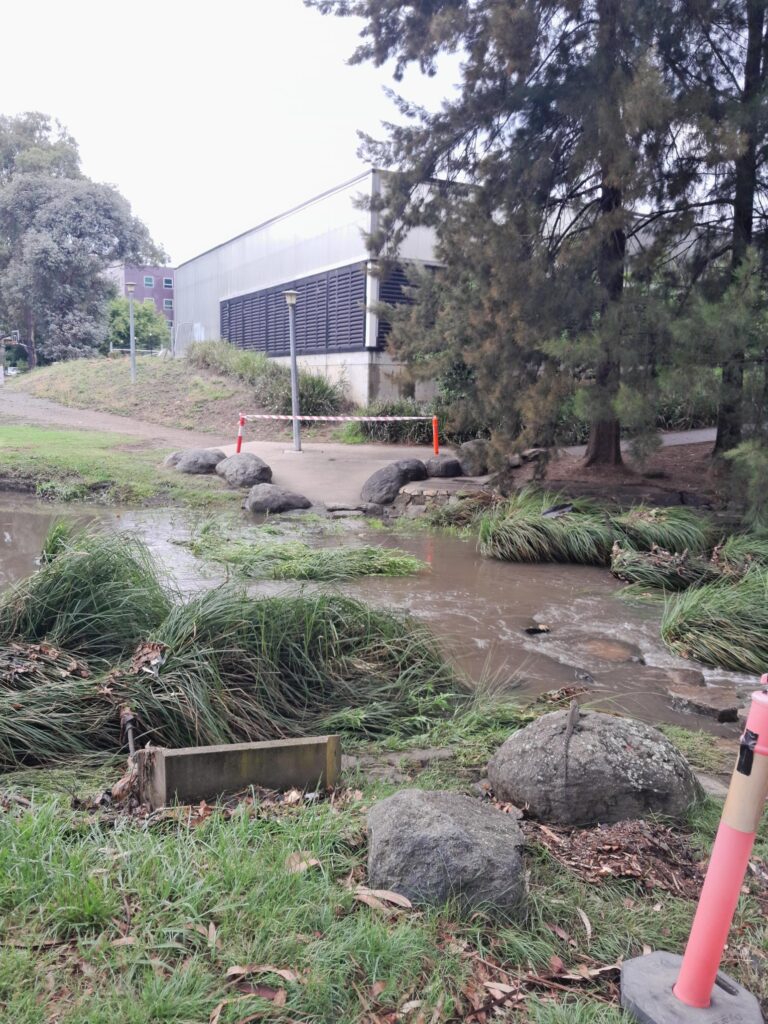
Figure 4 The ford at Norgrove Park, Kingston, ACT
Bibliography
Birkbak, A. (Forthcoming). Actor Network Theory and how to “do ANT” with qualitative or digital methods. In The research handbook on the Sociology of Science and Technology (pp. 1-17). Edward Elgar.
Conan-Doyle, A. (1890). The Sign of Four. In A. Conan-Doyle, The Sign of Four (p. Chapter 6). London: Lippincott’s Monthly Magazine, Spencer Blackett (book).
Eco, U. (1976). Introduction: Toward a Logic of Culture. In U. Eco, The Theory of Semiotics. Indiana University Press.
Eco, U. (1976). Signification and Communication. In U. Eco, The Theory of Semiotics. Indiana University Press.
Gane, C., & Sarson, T. (1979). Structured Systems Analysis: Tools and Techniques. Prentice Hall.
Grindrod, J. (2014). Concretopia: A Journey Around the Rebuilding of Postwar Britain. Old Street Publishing.
Hitchins, C. (2003). Orwell and “Englishness”. In C. Hitchins, Why Orwell Matters. Basic Books.
Lawrence, D. H. (2007). The Rainbow. Penguin Books Ltd.
MacKellar, D. (1908). My Country. The Spectator.
Magee, B. (1975). Popper. Fontana Modern Masters.
Shannon, C. (1949). The Mathematical Theory of Communication. In C. Shannon, The Mathematical Theory of Communication. University of Illinois.
Ulrich, W. (2005). A Brief Introduction to Critical Systems Heuristics (CSH). ECOSENSUS project website, The Open University, Milton Keynes, UK, 14 October 2005.
Weaver, W. (1949). Recent Contributions to the Mathematical Theory of Communication. In W. Weaver, & C. Shannon, The Mathematical Theory of Communication. Chicago: University of Illinois Press.
Wiener, N. (1950). Cybernetics. The American Academy of Arts and Sciences.
[1] https://www.litcharts.com/lit/the-rainbow/themes
[2] https://services.anu.edu.au/files/2024-06/JB%20Chifley%20Library%20collection%20rebuilding%20project%202018-2023_Final%20report%20for%20LAC.pdf
[3] For example, The Langton tetralogy by Martin Boyd, which, though not published as a series during his lifetime, is now referred to as a collective: The Cardboard Crown (London, England: Cresset Press, 1952), A Difficult Young Man (London, England : Cresset Press, 1955), Outbreak of Love (London, England: John Murray, 1957). When Blackbirds Sing (London, England: Abelard-Schuman, 1962)
[4] https://canvas.anu.edu.au/courses/5752/pages/fortnight-5-data-and-networking?module_item_id=427121 FQ ANT lecture 2026
[5] https://canvas.anu.edu.au/courses/5752/pages/fortnight-5-data-and-networking?module_item_id=427121 Fortnight 5.Mon2.AM.Network mapping workshop
[6] https://www.oaic.gov.au/privacy/privacy-guidance-for-organisations-and-government-“flexible” in strength eicagencies/privacy-impact-assessments/guide-to-undertaking-privacy-impact-assessments
[7] https://canvas.anu.edu.au/courses/5752/pages/fortnight-5-data-and-networking?module_item_id=427121 (Pages 3-4 Barramundi fish trap ‘Mandjabu’, Anchor Kulumba, National Gallery of Australia, Canberra, Australia collection)”
[8] https://canvas.anu.edu.au/courses/5752/pages/fortnight-5-data-and-networking?module_item_id=427121 (Pages 7-9)
Leave a Reply